The UK's Sustainability Reporting Standards (SRS), finalized earlier this year and built on the ISSB's IFRS S1 and IFRS S2, are changing what counts as a credible sustainability claim. The FCA is expected to confirm final reporting rules this autumn, following its CP26/5 consultation, which means companies have a narrowing window to prepare.
As Dcycle CEO Juanjo Mestre explained in a recent piece for ESG Today, the standard raises the bar considerably:
"Now, businesses are not expected to simply report upon their climate-related data, they need traceable and accurate evidence to back their claims."
That single sentence describes the gap a lot of businesses are about to discover in their own sustainability programs. For years, companies have made environmental claims in marketing materials, RFP responses, and investor communications without a consistent, auditable way to prove them. SRS closes that gap, and it does so by holding sustainability data to the same standard as financial data.
Why this reaches beyond compliance teams
The article makes a point that's easy to miss in the compliance conversation: SRS is reshaping how procurement decisions get made, from material sourcing to packaging suppliers.
"Even though the SRS is not a mandatory requirement for all businesses today, this reporting exercise has become critical to inform business decisions... As sustainability data increasingly shapes the decisions of procurement teams, businesses will need to demonstrate data traceability to know where to take the most impactful action."
For print, packaging, and MPS providers, that's the part worth sitting with. Many of your customers are the businesses this standard applies to directly, and as their procurement teams start weighing supplier decisions on traceable sustainability data, they're going to expect the same traceability from you that regulators expect from them. Even customers who fall outside SRS's scope, smaller businesses without formal procurement teams, are increasingly factoring sustainability into their purchasing decisions on their own.
Where PrintReleaf fits
This is the exact problem PrintReleaf was built to solve for the print and packaging industry. Customer print, paper and fiber-based materials usage data feeds directly into the PrintReleaf platform, which tracks and verifies the reforestation and carbon offsets that are generated in the equivalent amount. That gives partners a single, auditable data trail instead of a patchwork of self-reported claims.
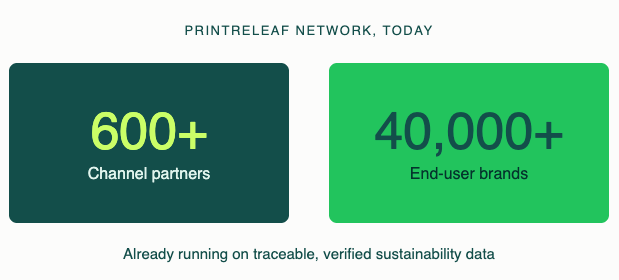
For the 600+ partners and 40,000+ end-user brands already working with PrintReleaf, this isn't a new system to stand up ahead of SRS. It's already in place. As buyers of all sizes start asking harder questions about supply chain sustainability data, PrintReleaf partners will already have the answer.
The takeaway
SRS is a UK standard today, but the underlying shift, from sustainability as a marketing claim to sustainability as a data discipline, isn't going away. Businesses that build traceable data into how they operate now will be the ones able to answer confidently when customers, investors, and regulators ask for evidence. PrintReleaf partners are already positioned to do that.